

A recap of a recent community conversation on reconciliation, land, and what it means for all of
us in British Columbia
If you’ve been following news out of BC lately – the Cowichan Nation court decision,
headlines about land title, social media posts warning homeowners they’ll be evicted –
you’ve probably felt some confusion, maybe even some anxiety. You’re not alone.
And most of what’s circulating online is wrong.
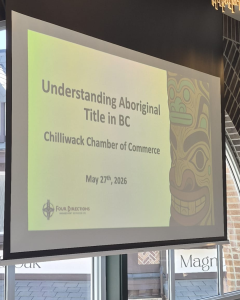
Our chamber hosted an open dialogue on Aboriginal rights and title featuring
Dan George, a proud member of the Gilseyhu Clan (Big Frog – Thin House) of the Wet’suwet’en people and president of a consulting
firm working in the reconciliation space since 1993.
Alongside Kelly, a researcher and practitioner
with 17 years of direct experience in this field.
Here’s what you need to know.
BC Is Genuinely Different – and That Matters for Business
Across most of Canada, the Crown negotiated treaties with First Nations. Those
agreements – however imperfect – transferred certain land rights and created a legal
foundation for settlement and resource development.
British Columbia is the exception. With very few exceptions (the Douglas Treaties on
Vancouver Island and a portion of northeast BC), BC is almost entirely unsurrendered
territory. The land was never legally ceded, sold, or surrendered by the First Nations
who occupied it.
This isn’t a political opinion. It’s a legal reality that courts have been affirming
consistently for decades – and it’s the reason why conversations about Aboriginal title
are happening here in ways they simply aren’t elsewhere in the country.
Aboriginal Title: What It Actually Is
Aboriginal title is not a new legal invention. It is not a political movement. It is not a
threat to private property.
It is a pre-existing right – grounded in First Nations’ occupation and governance of
territories for thousands of years before European contact – that has been recognized
and affirmed under Section 35 of the Canadian Constitution.
In practical terms, Aboriginal title includes:
• The right to exclusive occupation – the title-holding Nation can determine who
accesses the land and on what terms
• The right to use the land for any purpose – not just traditional or ceremonial
use, but economic decisions, conservation, development
• The right to the economic benefits of the land – as an ownership right, not a
royalty share
• Collective ownership across generations – it cannot be sold to private parties;
it can only be surrendered to the Crown, and only with the Nation’s consent
The Legal Journey Has Been Long – and Deliberate
Courts have been building this framework for over 50 years. Key milestones include:
• 1973 – Calder: Established that Aboriginal title existed before colonization
• 1997 – Delgamuukw: Recognized Aboriginal title to the land itself and validated
oral history as legal evidence
• 2004 – Haida Nation: Established the duty to consult and accommodate
• 2014 – Tsilhqot’in: The first ever declaration of Aboriginal title in Canadian
history – and a landmark for how title is proven and protected
• 2024 – Cowichan: The first declaration of title that includes an urban area – and
the case that’s generated so much recent confusion
Each decision adds a piece. No single case resolves everything. But the direction has
been unmistakably consistent.
What the Cowichan Decision Actually Said
This is where a lot of misinformation is circulating, so let’s be direct.
The Cowichan Nation court did not order any homeowners to leave their properties.
The decision distinguished between Crown title and fee simple (private) title. Aboriginal
title sits on top of Crown title – not on top of the private title that sits in your name on
your land deed.
The City of Richmond, in trying to defend itself, introduced the fee simple argument into
proceedings – and then complained when the judge addressed it. The Cowichan Nation
itself has been clear: they are not seeking to evict anyone. Their claim has always been
against the Crown.
“There has never been a claim for anyone’s home. The claim is against the
Crown – always has been.” – Dan George
Why This Matters for Business
This isn’t abstract. For anyone operating, investing, or making decisions in BC,
understanding this landscape is increasingly essential.
Aboriginal title and the accompanying duty to consult affect:
• Resource and infrastructure development approvals
• Environmental assessments
• Land use planning and permitting
• Investment certainty and project timelines
The businesses and industries that are moving fastest and with the most stability right
now are those that are building relationships first – coming to First Nations early,
treating them as partners and rights-holders rather than stakeholders to be managed.
Nations across BC are major and growing economic players. They own businesses,
operate casinos, hold equity in pipelines and resource projects, run tourism operations,
and employ thousands. First Nations represent the fastest-growing economic sector in
BC. Raising their economic standing raises the standing of the entire regional economy.
The Invitation on the Table
Dan and Kelly closed with something worth sitting with.
First Nations leaders in this region are not trying to break British Columbia. They are
trying to be included in it – as full partners in the economy, the environment, and the
future of the communities we all share.
The path forward isn’t winner-take-all litigation. It’s the kind of relationship-first approach
that creates certainty for investors, stability for communities, and a foundation that can
actually hold for future generations.
That requires us – business owners, community leaders, neighbours – to be informed.
To push back on misinformation when we see it. To show up to conversations like the
one our chamber hosted.
And to stay curious.
Resources mentioned in the session are available through the chamber. The next event
in this series is being planned – stay tuned.