
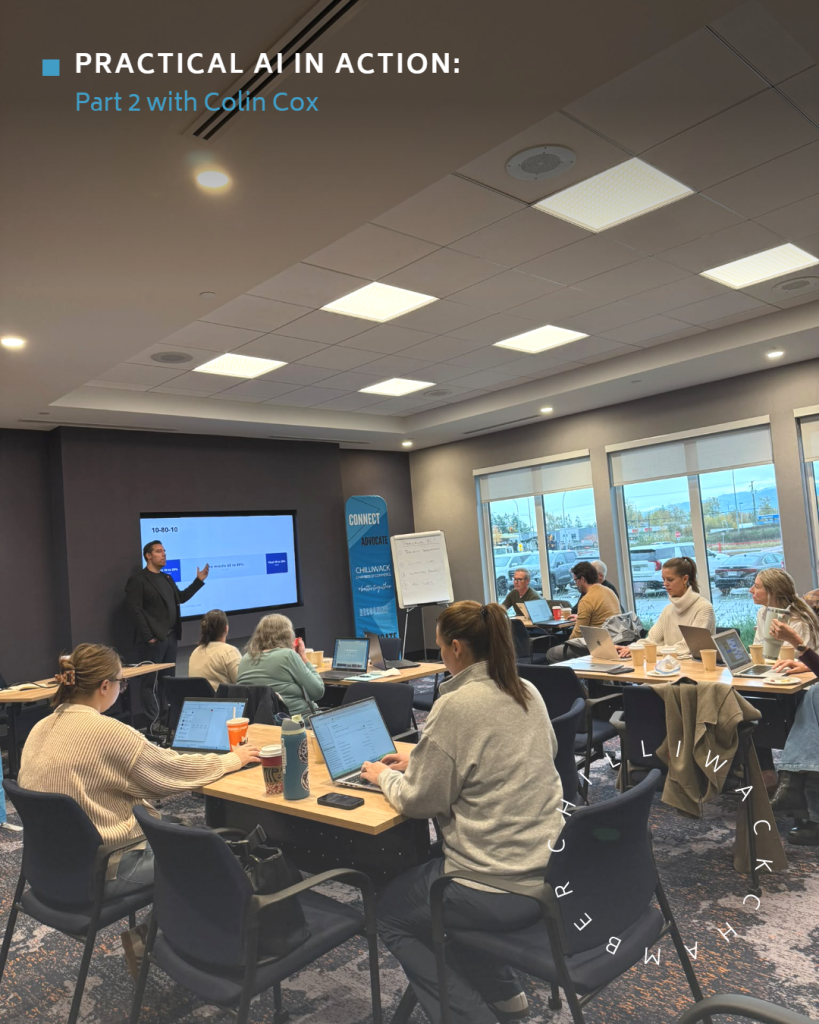
From smarter workflows to personal AI agents, Chilliwack businesses explored how artificial intelligence is transforming the way we work.
On November 10, 2026, the Chilliwack Chamber of Commerce welcomed Colin Cox for Practical AI in Action, Part 2, an interactive workshop held at Fairfield & TownePlace by Marriott Chilliwack.
Building on the foundations of the first session, the workshop explored how businesses can move beyond basic AI prompts and begin using artificial intelligence as a practical tool for everyday operations.
Through live demonstrations, real-world examples, and interactive discussions, Colin introduced participants to emerging AI capabilities, including connected software, reusable business context files, and personal AI agents.
Understanding the Technology Behind AI
One of the topics explored during the session was the distinction between AI companies, applications, and the underlying models that power them.
Colin explained how platforms such as ChatGPT, Claude, and Microsoft Copilot provide different user experiences, even when they use similar underlying AI technology.
He also discussed how choosing an appropriate AI model can affect performance, efficiency, and usage limits.
For businesses, understanding these differences can help inform decisions about which tools are best suited to particular tasks.
Giving AI the Right Context
A recurring theme throughout the workshop was the importance of providing AI with meaningful context.
Colin introduced a simple framework for improving AI instructions:
Role + Context + Task
By clearly defining the role AI should take, providing relevant background information, and explaining the desired outcome, users can produce more focused and practical results.
Participants also learned about business context files: reusable documents containing information about an organization’s purpose, services, customers, values, and priorities.
Rather than repeatedly explaining the same information, businesses can create these resources once and use them across projects such as marketing campaigns, website updates, and internal communications.
Connecting AI to Everyday Business Tools
The workshop also demonstrated how AI can connect with existing applications, including email, calendars, customer relationship management systems, and other software platforms.
Using a personal finance application as an example, Colin showed how AI could analyze information and identify trends through natural-language requests.
The demonstration illustrated a broader shift toward what is sometimes described as headless software, where users can interact with software capabilities through AI rather than navigating traditional interfaces.
For businesses, these developments create opportunities to streamline workflows, access information more efficiently, and reduce repetitive administrative work.
The Rise of Personal AI Agents
One of the most engaging discussions focused on personal AI agents.
Unlike traditional chatbots that primarily respond to questions, AI agents can be configured to assist with specific responsibilities, access connected information, and support multi-step tasks.
Colin shared how he uses a personal AI assistant to help coordinate responsibilities across his businesses.
He also described creating specialized agents for different functions, including finance, allowing each assistant to maintain its own instructions and relevant context.
This approach can help individuals and organizations manage complex responsibilities without requiring one AI assistant to handle every detail.
The discussion also explored how personal AI assistants may increasingly support everyday activities such as scheduling, email management, and administrative coordination.
While the technology continues to develop, these examples offered participants a glimpse into how AI may become a more integrated part of both professional and personal workflows.
Balancing Innovation with Responsibility
Alongside the opportunities, the session emphasized the importance of responsible AI adoption.
Connecting AI to business systems requires careful consideration of privacy, data security, access permissions, and organizational policies.
Colin also shared examples demonstrating that even capable AI applications can make mistakes or fail to complete tasks as expected.
These limitations reinforce the importance of human oversight, particularly when AI is working with sensitive information or taking actions on behalf of users.
Helping Chilliwack Businesses Prepare for What’s Next
As artificial intelligence continues to evolve, understanding its practical applications is becoming increasingly valuable for businesses of all sizes.
Workshops such as Practical AI in Action provide opportunities for local professionals to explore emerging technologies, ask questions, and consider how new tools can support their operations.
The Chilliwack Chamber of Commerce extends its appreciation to Colin Cox for sharing his expertise and to everyone who participated in the workshop.
The key takeaway: AI’s greatest value may not be in how many questions it can answer, but in how effectively it can help people get things done.
To learn more about upcoming workshops, networking opportunities, and business events, visit the Chilliwack Chamber of Commerce events calendar.