
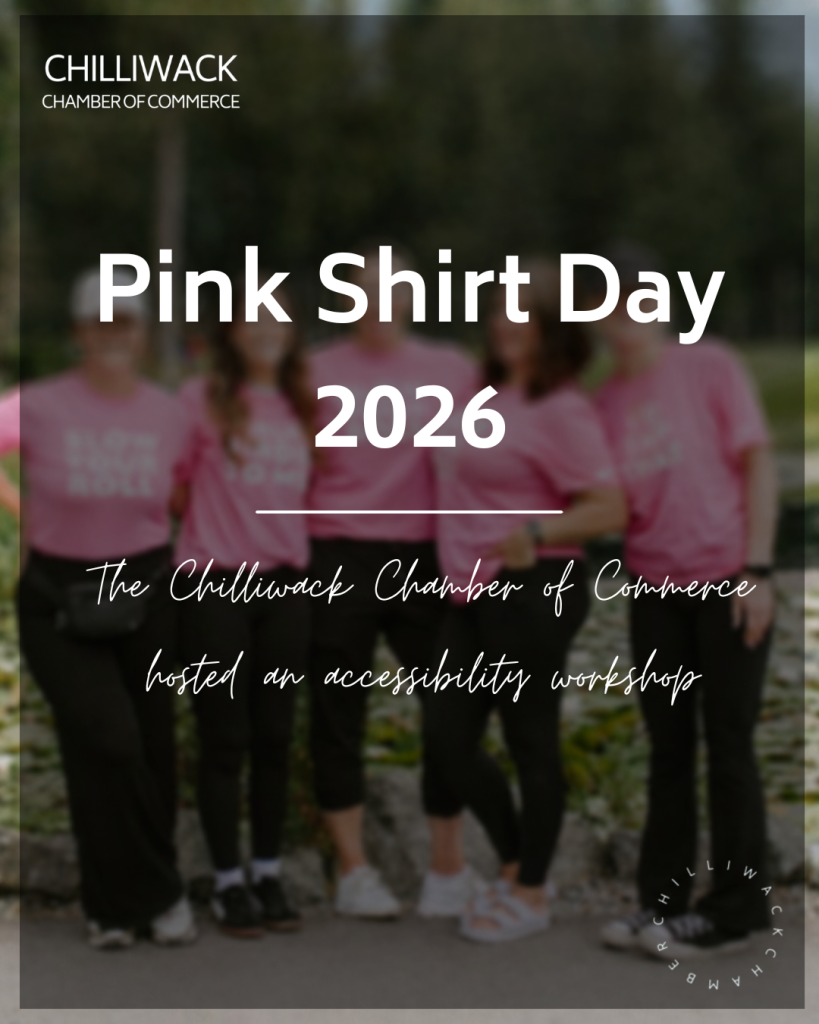
On Pink Shirt Day 2026, the Chilliwack Chamber of Commerce hosted an accessibility workshop to explore a simple but powerful idea: accessibility is how we remove barriers so more people can participate with dignity.
Pink Shirt Day is about disrupting bullying and creating safer spaces. Accessibility is one of the most practical ways we do that—because barriers (physical, sensory, digital, social, and attitudinal) can exclude people long before they ever walk through the door.
A bit about the lens behind this workshop
Our facilitator shared lived and professional experience: parenting a now-20-year-old who was born with disabilities, years of inclusive photography work with disabled models and community members, and ongoing involvement with accessibility committees (including Destination BC, a local school district, and leadership with Inclusion Chilliwack). A key commitment throughout the session: respect, consent, and boundaries—especially when sharing stories involving family members.
What accessibility is (and what it isn’t)
Accessibility is removing barriers and creating pathways to participation—whether you’re offering a service, hosting an event, hiring staff, building a space, or publishing information online.
One important reframe from the workshop: “Fully accessible” doesn’t really exist.
Instead, ask: “Who is this accessible for?” and “What barriers still exist—and how can we reduce them?”
What helps one person can create challenges for another (lighting, sound, layouts, scents, pacing, etc.). The goal is progress, not perfection.
Disability and barriers: the social model
A core theme was the social model of disability: people aren’t “disabled” because of who they are—they’re disabled when environments, systems, and attitudes create barriers.
And the biggest barrier is often not the built environment. It’s the attitude barrier—assumptions about capability, discomfort with difference, or the belief that access is “extra.”
Disability can be visible or invisible
The workshop highlighted how broad disability is, including (but not limited to):
- Mobility disabilities
- Sensory disabilities (hearing/Deaf, vision/blindness, sensory processing)
- Intellectual and learning disabilities
- Mental health disabilities
- Chronic illness, fatigue, pain
- Brain injury
- Neurodivergence (ADHD, autism, dyslexia, etc.)
A key takeaway: many people facing barriers do not identify as disabled, and many never receive a formal diagnosis. So the most helpful question often isn’t “Do you have a disability?” but:
“Are you experiencing any barriers, and how can we support you today?”
“Spoon theory” and why energy matters
Accessibility isn’t only about ramps and washrooms. It’s also about energy.
The workshop used “spoon theory” to describe fluctuating capacity—especially for chronic illness, pain, fatigue, and mental health. Some days a person may have plenty of “spoons” (energy units). Other days they may have only a few—so things like long wait times, unclear instructions, extra steps, and sensory overload become major barriers.
Practical ways to improve accessibility (low-cost, high impact)
Many changes discussed were time-based, communication-based, or policy-based, not expensive renovations.
1) Put accessibility information where people can find it (before they arrive)
Create a simple Accessibility section on your website and/or event listings. Include what you know, for example:
- Step-free entrance / ramps (and where they are)
- Door width (if you can measure)
- Accessible washroom availability and route (clear pathway, not used as storage)
- Seating options (regular-height tables, space for mobility devices)
- Lighting and noise (can you reduce music? offer a quieter corner?)
- Parking realities (if the lot is challenging, name that honestly)
- Service options (can you take payment/orders differently if needed?)
- Who to contact for support, and what kind of flexibility you can offer
When people face barriers regularly, they plan ahead—because showing up and discovering they can’t enter costs time, energy, and dignity.
2) Design for sensory comfort where possible
Small choices can change everything:
- Reduce visual clutter where you can
- Offer a quieter space at events (even a small room or corner)
- Consider scent (strong fragrances can be a barrier)
- Provide predictable flow: clear signage, what-to-expect, schedules
3) Communicate clearly and in multiple ways
- Use plain language (aim for clarity over complexity)
- Provide step-by-step instructions and “what to expect”
- Share materials in advance when possible
- Offer captions, written summaries, or interpretation when relevant
- Remember that “digital-only” participation excludes some people—offer alternate ways to engage (phone, in-person support, printed info)
4) Reduce wait-time barriers
Long holds, lineups, and confusing systems drain people’s limited energy. Wherever possible: callbacks, timed entry, clear updates, and flexible scheduling help.
5) Cost shouldn’t block support people
If someone needs a support person to participate, accessibility means that support person shouldn’t be an additional barrier or extra cost to accessing community life.
Inclusive workplaces: flexibility is access
The workshop shared an approach many teams can adopt immediately: build invisible buffers.
Example: set internal deadlines earlier than the real deadline to account for fluctuating capacity, caregiving needs, and mental health—without last-minute pressure or shame.
Other ideas discussed:
- Offer flexible work blocks (split shifts, rest breaks, varied start times)
- Normalize asking about barriers (“What would make this easier to do well?”)
- Recognize stigma: some people won’t disclose diagnoses—so build systems that don’t require disclosure to receive support
Ableism: a word worth knowing
Ableism was defined as the belief in a hierarchy of capability—the idea that some bodies and minds are “better” or more valuable than others.
A simple language check shared in the workshop:
If you wouldn’t say it about a woman (or another protected group), don’t say it about a disabled person.
Language shapes culture, and culture shapes access.
A simple process to keep making progress
A practical 3-step method shared from 20 years of lived experience:
- Name the barrier (we noticed it)
- Take action (reduce or remove it)
- Make it “how we do things now” (update policy, checklists, templates)
This helps teams move forward without getting stuck in perfectionism.
Inclusion, segregation, and belonging
The workshop introduced a useful lens:
- Exclusion: people can’t participate
- Segregation: people are present but separated/limited (sometimes a necessary step, sometimes not)
- Inclusion: barriers reduced; dignity protected
- Belonging: not something you “give”—it’s something people feel when inclusion is real
Tools and resources shared
Participants were pointed toward several free or low-cost ways to learn and act, including:
- Provincial accessibility guidance (BC-focused resources for accessible experiences online and in-person)
- Accessible event planning toolkits
- Inclusive hiring guidance
- A free trial website accessibility scanning tool that can generate a report of issues and improvements (useful for quick wins and prioritizing fixes)
Closing: why this mattered on Pink Shirt Day
Pink Shirt Day asks us to create environments where people aren’t pushed out—by cruelty, by systems, or by silence. Accessibility is part of that promise.
If you take one step this month, start here: choose one barrier to name, one action to take, and one way to make it your new normal.
Want support or have a question about accessibility in your space, events, or communications? Reach out to the Chamber—we’d love to help keep the conversation moving.
For more information, you can also explore the following resources.
https://www.chilliwackchamber.com/wp-content/uploads/2026/02/Share-Accessibility-as-a-practice-Feb-2026-1.pdf
https://www.chilliwackchamber.com/wp-content/uploads/2026/02/Inclusive-Ai-feb-2026.pdf